Saturday, July 13, 2024
Oppenheimer
Tuesday, December 28, 2021
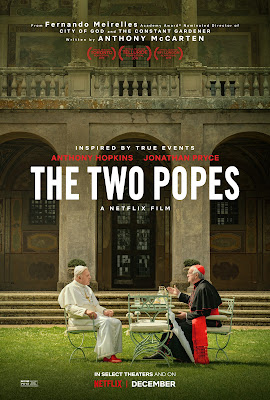
The Two Popes
- The way in which it explored Benedict's and Francis's disputes about theology and the proper role of a leader. Should a leader establish and maintain firm standards, or should he/she empower other people to discover the standards that work best? Benedict clearly holds more of a black-and-white view of Catholicism, while Francis has a streak of relativism. The dialogue between the two of them (especially the conversation in the garden, when they first meet) is powerful in the way that it illustrates the strengths and weaknesses of each perspective.
- The way in which both characters are fleshed out and feel truly human (notwithstanding their special status) -- a credit to both the actors and screenwriters. For me, Benedict has always been a bit off-putting, in his expressions and demeanor. The version of Benedict in this film, however, is vulnerable and fragile, and that enabled me to empathize with him and with his perspective.
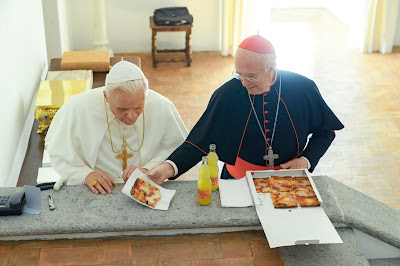
- The element of humor. I really enjoyed the way that the two popes jousted with their words and the way some of this jousting had a humorous overlay. Also, the pizza scene and the tango scene (among others) reminded me of the importance of having fun with our lives.
- The way in which the two popes slowly built a genuine friendship with each other, which reached a climax when each confessed. I have rarely seen a film do a better job of showing two people gradually connecting on both the intellectual and spiritual levels.
Tuesday, June 23, 2020
Learning About Gloria Steinem and Phyllis Schlafly in Mrs. America
My favorite television show of quarantine has been Mrs. America, a nine-part miniseries that examines the lives of the famous (and less famous, but equally affected) women who fought for and against the Equal Rights Amendment.
There are few things I like better than a book, movie or TV show that fictionalizes history in an engaging way -- and that introduces the major personalities, events and issues while remaining reasonably faithful to "the truth."
For me, Mrs. America presents 1970s feminism, and the battle over the ERA, in a way that highlights the stakes (the political and emotional ones) with subtlety and complexity. I've heard about Phyllis Schlafly since college, but I'd never taken the time to learn about her specific role in the political battles of the 70s and 80s; I'd certainly heard Mom and Dad talk about Gloria Steinem through the years.
Interestingly, I probably knew more about Bella Abzug and Betty Friedan than either Schlafly or Steinem, by virtue of my Women's History course with Annelise Orleck (in addition to Kenneth Shewmaker's course about American foreign policy, Women's History may have been the class that influenced me the most). I loved the show's portrayals of Abzug and Friedan, particularly seeing the way in which many feminists were both inspired and frustrated by Friedan (in particular, by her opposition to spotlighting and fighting discrimination based on sexual orientation).
Schlafly is a fascinating figure. She figured out how to use the American political system at both the grassroots and institutional levels, and she maneuvered her way to considerable success. Mrs. America shows how hard she is to like or respect, even while making it nearly impossible not to credit her with effectively using our democratic system to advocate for her perspective.
Every performance in the show is stellar; in that sense, I am reminded of The Wire, Six Feet Under, and the other ensemble programs for which I'd have difficulty choosing a "favorite" cast member. As I cross my fingers hoping for a second season, this is the kind of pop culture that makes me feel grateful to be living in the era of peak TV.
Wednesday, June 3, 2015
American Sniper (2014)
Kyle was a Navy Seal who, during four tours of duty in Iraq, became the most lethal sniper in US military history; he killed at least 160 Iraqis. I remember learning about Kyle's death in 2013, when a fellow veteran (whom he was attempting to help) shot him at a shooting range. I remember thinking that his death seemed a tremendous irony, and I also recall that there was some controversy at the time about the details of his biography.
Over the course of the movie, Kyle begins to question his personal motivation for fighting, which was reminiscent of The Hurt Locker. The way that he prioritized his brothers-in-arms over his wife and family also reminded me of The Hurt Locker.
In terms of the larger geopolitical questions about America's involvement in Iraq, I think Generation Kill raised more questions and better conveyed a sense of moral ambiguity.
599. How many American soldiers have died in Iraq in 2015? I remember that a helicopter was shot down in Afghanistan earlier this year, but have there been any casualties in Iraq?
After watching American Sniper, I was curious about the historical authenticity of the Syrian sniper Mustafa, who Kyle pursues for several years. I gather that there was a sniper who had competed in the Olympics for Syria, but that the interweaving of Kyle and Mustafa's stories was more of a narrative artifice.
Saturday, May 30, 2015
Wolf Hall
This spring I watched Wolf Hall on PBS. An adaptation of a novel by Hilary Mantel, Wolf Hall tells the story of Thomas Cromwell from his time as Cardinal Woolsey's assistant until the beheading of Anne Boleyn.
This is a spectacular show. I was completely immersed in the historical details and the beautiful scenery. Mark Rylance plays the role of Cromwell and is in almost every scene. I understand that Rylance is a well-known British stage actor, but I'd never seen him before. His acting is mesmerizing: I wanted desperately to know what Cromwell was thinking about his various maniupulations, and Rylance dropped clues here and there, but for the most part he remains an enigma.
My favorite character, though, was Anne Boleyn (played by Claire Foy). She comes across as mean, power-hungry, self-centered -- and yet, at the heart of it, fragile. She seems real. She repeatedly pronounces Cromwell's name with a French accent; I think this is supposed to be a put-down, but somehow it reveals her own insecurity. Is this what's meant by "pathos"?
591. Queen Elizabeth's ultimate triumph (personal, political, historical) seems like one of the great ironies of history, in light of her mother's beheading and the back-story of Henry's disappointment in having another daughter. At what point in her life did Elizabeth first exert herself? Did Henry realize the greatness in his daughter, prior to his death?
592. How did Elizabeth feel about her mother? How did she feel about Henry? Did she have more loyalty to her father, as monarch, despite his ruthlessness and cruelty?
593. Do William and Kate like to watch historical movies about the British royal family? Is William as pensive and "outside-the-box" as his father?
594. What's the most popular movie about the British royal family?
595. Damian Lewis does a terrific job as Henry VIII in Wolf Hall. At first, he reminded me too much of his role as Brody (from Homeland), but then his pompous craziness became believable and frightening, and I couldn't turn away. What was Henry really like? Was he a mad genius truly interested in the good of his country, or was he just a cruel tyrant blinded by his power?
Monday, August 5, 2013
Fruitvale Station
Last Thursday I saw Fruitvale Station after listening to a Bill Simmons interview with Michael B. Jordan, who plays Oscar Grant (and who played Wallace in The Wire). Grant was killed on January 1, 2009 by a Bay Area Rapid Transit security officer at the Fruitvale subway station in Oakland. I did not know about Oscar Grant prior to this movie. He is portrayed as a very sympathetic (if flawed) character. Like Daisy in Sisterland, Oscar has a young child, on whom he dotes. I am discovering that at this point in my life, I particularly like movies and books about parenthood.
Jordan's acting is powerful: he shows Grant having a range of different demeanors and perspectives ("masks"?), depending on the context and the person to whom he is talking. Grant is incredibly devoted to his mother, yet he has a temper that can be dangerously uncontrollable.
Although the shooting is very clearly portrayed as unjustified, there is some level of ambiguity about the climactic scene and how the incident unfolded. This scene shows the complexity of narrative (and echoes the different perspectives on what happened between Trayvon Martin and George Zimmerman).
My major problem with the movie is the one identified by several critics: there are too many story-telling artifices (such as the white woman whom Grant befriends at the grocery story, who inadvertently starts the subway fight). These artifices clutter or detract from the tragedy at the center of the story.
Given how powerful the movie is, however, I am reluctant to complain about its flaws: Oscar Grant is one of the more fully-illustrated people from any movie I've seen, and I will not forget his story.
Tuesday, July 30, 2013
The Bridge
This summer, H. and I have watched the first three episodes of The Bridge. We watch it on Hulu, continuing the trend of not watching most television on "live" TV.
The Bridge is a detective/cop story about crime along the US/Mexico border. The specific locales are El Paso and Juarez. It's based on a show about the Denmark/Sweden border which I gather got rave critical reviews.
So far, I am a big fan of this show. Like Homeland, it has a male and female in dichotomous lead roles. In fact, Episode 3 includes a dialogue about the meaning of the word "dialectics" in which Sonya Cross (the female lead) explains that it refers to poles: wealthy/poor; safe/dangerous; etc. -- she could also have referenced the polar perspectives of herself and her partner, Marco Ruiz.
The theme of poles creates considerable dramatic tension, and Sonya and Marco have some interesting quirks. Sonya is extremely literal and socially awkward. Marco seems to walk the fine line between working alongside a shady drug lord while pursuing justice.
The identity of the perpetrator/criminal is completely unclear so far, but he is motivated at least in part by a desire to highlight the different levels of attention that are paid to crime victims in the US and immediately across the border.
583. Enrique Pena Nieto became the President of Mexico on December 1 of last year. Has he had any success so far in combating the drug trade? I think that a major cartel leader may have been either arrested or killed over the winter.
Sunday, January 20, 2013
Zero Dark Thirty (2012)
Tuesday, December 18, 2012
Argo (2012)
Saturday, October 20, 2012
Homeland
We recently finished watching the first season of Homeland.
What a great show. I love the way that the two main characters provide different reflections of America in the age of terrorism, security, surveillance, suspicion.
And the suspense was intense!
The acting is superb (although I did start to get a kick out of certain facial tics by Claire Danes).
I also like the family/husband/father aspects of Sargeant Brody's story.
Homeland supports the proposition that television is better than film nowadays.
Beginning with Six Feet Under (for me personally, at least -- I think most people trace this phenomenon to The Sopranos), good long-form television series provide significantly more depth-of-character than do most movies.
As illustrated by the Claire Danes and Damian Lewis characters, long-form TV lets the writers, directors, and actors develop characters. Compared to (most) movies, shows like Homeland, The Wire and Mad Men are thematically and narratively complex. They show the way that relationships evolve and people change from day-to-day and year-to-year.
I have a hunch that the really creative people in Hollywood today are drawn to television moreso than film (I'm looking at you Jon Brytus!).
I hope that there will continue to be shows like this that are interesting, provocative and fun.
Thursday, March 15, 2012
Game of Thrones
I've watched the first three episodes of Game of Thrones this week.
To my surprise, I have thoroughly enjoyed the show so far (Tuck and Dan, I hear the laughter, but watch a couple episodes before you tease too much).
I like:
- The characters
- The focus on family dynamics (in particular the sibling and parent-child relationships in the Stark family)
- The scenery (a somber blue medieval)
- The funky accents
- The kitsch performance by King Robert Baratheon
- The dramatic overlay of geopolitics
Two of the great film disappointments of my life were (1) the second trilogy of Star Wars and (2) the Lord of the Rings movies.
In those movies, there was not enough emphasis on character. The mythology hit you over the head, instead of developing through the storyline. The humor fell flat.
Game of Thrones, on the other hand, reminds me of the original Star Wars films and the Lord of the Rings books. There's some subtlety. The characters are complex -- gray like the scenery. The humor works.
Most importantly, I am genuinely curious to know what's going to happen. This strikes me as a sign of a good story.
Sunday, September 5, 2010
Patton Oswalt in Big Fan (2009)
The movie explores fandom. The central character, Paul Aufiero (played by Patton Oswalt), is a 35-year old who grudgingly lives with his mom and whose sole reward in life is following the New York Giants. He is a good-hearted person who tries to get along with his family, works hard (as a parking lot attendant), nurtures his one friendship, and -- in one of the more interesting subplots -- is really polite.
Aufiero repeatedly calls a local sports show (under the tag "Staten Island Paul") and comes out of his shell (a little bit) in his pre-written odes to the Giants. He and his bud Sal go to all the home games, even though they're relegated to watching from a television in the parking lot.
The movie was written and directed by Robert Siegel, and I am an immediate fan of both Siegel and Oswalt (I didn't previously know of either, though I remember this movie getting talked up last summer on the Culture Gabfest and elsewhere).
On a personal level, the movie made me think about my own fandom. On a social level, it made me think about the phenomenon of human tribalism and how sports teams might actually be a really good outlet for people's tribal energies, which can otherwise be funnelled towards more violent channels.
467. Did Oswalt get any nominations for acting awards for Big Fan? Not only was his character extremely well-written, but his acting job was tops.
468. The film uses real NFL player references. Did they have to get special permission to do so? It kind of surprised me that real players were referenced, given the dark tone of the movie.
469. I went to UVa's season opener last night with Chap and his friend Chris. We beat Richmond, 34-13, to inaugurate the Mike London era. The game was close until the fourth quarter, and it was a gorgeous Charlottesville evening. How many wins for the new Hoos? I predict 6-6, which I think would bode well for building the team into the future.
Saturday, September 4, 2010
The American (2010)
The film is decent but somewhat disappointing. Perhaps a 6.5 out of 10?
The overriding characteristic is that it's extremely slow -- long stretches where there's no dialogue and no music, and you just watch George Clooney brood (unfortunately it's not clear what he's brooding about). The slowness was appealing at times (as a nice antidote to the standard non-stop action blockbuster), but I wanted more character study.
There are a number of strange scenes where Clooney works on assembling a high-powered rifle, and I was honestly reminded of either MacGyver or The A-Team, except that in these scenes I think you are supposed to be moved by Clooney's focused energy (whereas those others played up the kitsch).
There's also a subplot with the local priest, and those scenes have some of the film's more interesting dialogue about relativism and sin. The prostitute Clara is an interesting character who brings a little bit of life to Clooney. And the scenery of Italy is gorgeous (it reminded me in particular of Cortona) -- those pictures were actually worth the price of admission.
Alas, though, the movie falls short on the character (or lack thereof) problem.
Sunday, August 1, 2010
Mad Men, Season 4
We watched the first episode of Season 4 on Friday night. It was excellent: I've gone from being lukewarm towards this show for parts of Seasons 2 and 3 to being very interested again.One of the subplots I particularly like is the focus on Don and his partners' conception of how to structure and operate their advertising agency. At the end of Season 3, they split from the British conglomerate that had purchased Sterling Cooper (and which was in the process of making the business increasingly impersonal and factory-like).
From the very beginning, I had liked that Mad Men is about the workplace (making it relatively unique among shows/books/movies), but somewhere in Season 2 it became too much a soap opera about Don's unfaithfulness -- just one cheating episode after another. The focus on his affairs made Don very unlikeable and, more generally, it made the stories less compelling.
Now, though, we've gotten back to more interesting story lines about the trickiness of office politics (including gender politics), "big" versus "small" in the business world (with the new version of Sterling Cooper representing the small, scrappy up-start), the overlay of American political developments (including the Kennedy assassintation and the Mississippi civil rights murders), public relations strategies, and attitudes towards homosexuality in early 60's America.
The best of the episodes are like social history lessons rather than a cheesy soap opera. And the visuals of the show remain excellent: the different colors, decor (the office architecture is fun to see), cool outfits, and old-time habits (including the crazy amounts of smoking and drinking) are a window into a not-that-distant but very different world.
Sunday, January 24, 2010
Up in the Air (2009)
Up in the Air is a story for the times. The close-up interviews of people talking about losing their jobs (these are at the beginning and end of the film) bring home the jarring effects of unemployment and job loss -- more than any newspaper article can do.George Clooney plays Ryan Bingham, who travels around the country laying people off and who is very satisfied with his no-strings-attached lifestyle.
Clooney captures the attitude really well, in his monologues about travel and during the seminar scenes on "What's in Your Backpack?"
His perspective on relationships gets more complicated when he meets Alex, who is played by Vera Farmiga and who is ostensibly as detached from relationships as Clooney. The third main character -- Natalie -- is a new hire at Clooney's company who's determined to put the firing process online. Natalie is played by Anna Kendrick (who is brilliant) and her outlook (yes on relationships, yet no on human contact) is a really good foil to Clooney's.
I am generally a Clooney fan; he won me over with the first Ocean's Eleven and ever since then his suavity (?) gives me a chuckle. I also like that he's politically engaged but does not seem quite as self-righteous as some of the Hollywood stars (I'm thinking here of Brad Pitt, Tim Robbins and perhaps also DiCaprio).
Clooney's character is determined to collect 10 million frequent flyer miles on American Airlines. I really like this subplot because of the way that his motive is completely unclear. He does not want the material rewards (he actually lives a pretty spartan lifestyle), nor is he looking to an early retirement. He's not showing off for anyone (although he does come around to connecting with his siblings, which is a great part of the movie).
He just wants to attain the goal. This storyline made me think about the goals that we set for ourselves and the reasons we do so: do all of us have things we're striving for without knowing just why?
Saturday, January 23, 2010
A Single Man (2009)
We went to see A Single Man last night at Vinegar Hill.I liked this movie, notwithstanding that it's sad to the extreme: the scene in which George is told over the phone that his partner has been killed in a car accident -- and that George is not invited to the funeral -- is one of the most powerfully emotional scenes that I've seen in a long time.
The movie is based on a book by Christopher Isherwood, who I had not previously heard of and who was one of the first writers to address and examine homosexuality. The story is as much about emotion as plot, and Colin Firth does an amazing job of conveying one person's emotional life, including the way in which your feelings can change not only during the course of a day but even during the course of a conversation.
George is an English professor and appears to be in his early 40's; he was with his partner Jim for 16 years, and the short scenes where they're shown together (in particular, the scene in which they are reading together and talking about their dogs) convey their closeness, connection and affection. He's also got a quirky, ambiguous (?) relationship with Julianne Moore's character, who wants the two of them to be a couple following Jim's death.
The music in this movie was perfect - it was the polar opposite of the Avatar music (my critique is here), which didn't add to the images at all. Here, the music complemented the emotion without being melodramatic, and it made me appreciate the film medium: I don't think I'd have gotten as much out of the story either reading it or seeing it as a play.
The director of A Single Man is Tom Ford, who I read this morning was formerly the creative director of Gucci. The Gucci connection makes sense given the beautiful aesthetics of the different scenes (excluding a few that went over the top, as per Manohla Dargis's review: "at times Ford's taste seems too impeccable, art-directed for a maximum sale, as in a black-and-white flashback that brings to mind a perfume advertisement").
Movies, like books, work for me when they get me on multiple levels: mental, emotional, funny-bone, visual, musical, appreciating the art of acting, etc. This one does that; it's a well-done work of art.
Saturday, January 9, 2010
Avatar (2009)
I'm more than a bit embarrassed to admit this, but Titanic is a movie that I really liked. I think it was a combination of (1) the historical aspect (I enjoyed seeing the portrayal of people's manners and interaction at that time), (2) Leonardo DiCaprio's cool swagger (he played the underdog role to a tee), and (3) the James Horner soundtrack which I thought perfectly fit the story.
Avatar, alas, didn't do it for me.
The storyline was just too generic and predictable: it was essentially Dances with Wolves in outerspace.
In particular, the relationship between the two main characters had no depth and no unexpected twists: from her initial reluctance, to his winning her over with his willingness to try new things and experience the foreign culture, to his ultimately fighting to defend her from the human imperialists.
Another disappointment was the James Horner music. Whereas Titanic's soundtrack fit the story so well, this music seemed as though it could have been written as the background for any of a number of movies.
There were some things about the movie that I enjoyed:
- The 3-D: it made for a new moviegoing experience, even if I disagree with people who are predicting that 3-D will become much more common in Avatar's wake. Incidentally, I unknowingly drove halfway home on 29 with my 3-D glasses still on - yikes.
- The colors - from the many shades of blue to the wild reds and pinks of the flowers, the colors in this movie were visually interesting, relaxing, and fun.
- The imaginary creatures. Bradley had told me she was reminded of the experience of seeing Star Wars as a kid, and I felt this too. It's nice to go into total imagination mode and travel to other worlds.
David Brooks had an excellent piece in this week's Times explaining the problem with Avatar. It's here, and here's an excerpt:
The white guy notices that the peace-loving natives are much cooler than the greedy corporate tools and the bloodthirsty U.S. military types he came over with. He goes to live with the natives, and, in short order, he’s the most awesome member of their tribe. He has sex with their hottest babe. He learns to jump through the jungle and ride horses. It turns out that he’s even got more guts and athletic prowess than they do. He flies the big red bird that no one in generations has been able to master.
Along the way, he has his consciousness raised ... The natives help the white guy discover that he, too, has a deep and tranquil soul.
The natives have hot bodies and perfect ecological sensibilities, but they are natural creatures, not history-making ones. When the military-industrial complex comes in to strip mine their homes, they need a White Messiah to lead and inspire the defense.
Sunday, December 27, 2009
Julie & Julia (2009)
Meryl Streep was very endearing as Julia Child. Even though I've only seen the briefest of snippets from Child's television show, she seems like a highly likeable person: genuinely enthusiastic about the joy of food and preparing it.
I continue to be interested in people who have passions, and the movie is the story of two passions: Julia Child's discovery of her passion for cooking, and Julie Powell's discovery (by way of working through all the recipes in Child's Mastering the Art of French Cooking, and then blogging about them) of her passions for cooking and writing about it. Now that I'm thinking about it, the parts of the movie about Child do not focus as much on the writing of the cookbook, although there are a number of scenes about her relationships with her two French collaborators.
395. What are the similarities and differences between writing and cooking? I guess one similarity is that both are primarily solo activities, but a difference is that cooking is more tactile whereas writing occurs more in the mind.
396. I see that this movie was nominated for Best Musical/Comedy by the Golden Globes and that Streep is nominated for Best Actress. Which movies and actors/actresses will be the primary contenders for the Golden Globes and Actors? On Slate's Culture Gabfest, they've said that The Hurt Locker will get a nomination for Best Picture, and I think that's right-on -- it was my favorite movie of the year. I imagine that Morgan Freeman will get a nod for Invictus.
397. Did Julia Child really discover her passion for cooking as accidentally as it's portrayed in the movie? Or was that a bit of dramatic license -- was she in reality a more ambitious person than the film makes out?
398. Is Rachael Ray the top-selling cookbook writer at the moment? There's a great piece in this morning's New York Times where they have essays about each year of the decade, and Anthony Bourdain's essay for 2007 (here) talks about the way in which chefs' newfound celebrity enables them to -- at long last -- refute the claim that the customer is always right:
The best news of 2007 was that chefs, as a social class somehow empowered by the strange and terrible glare of celebrity, were finally free to rid themselves of the time-honored dictum of “the customer is always right.” If experience had taught chefs anything, it was that this is very rarely the case. Chefs were now trusted enough to persuade customers to try what they themselves loved to eat.
Friday, December 11, 2009
Star Trek (2009)
We watched Star Trek last night. It came out in May of this year and is the back-story of the "Starship Enterprise" crew. It was entertaining: a good mix of pop-style philosophy, space saga music, funny bad guys (they looked a lot like the bad guys in the new Star Wars movies), and relatively interesting character development.I think I've seen either two or three of the old Star Trek movies, so I knew at least the basics of Captain Kirk and Spock but was unclear on many of the subtleties and relationship details between the various crew members.
The movie was directed by J.J. Abrams, who is the co-creator of Lost.
The most interesting philosophical issue that the movies examines is time travel and interacting with the future. The links between the past, present and future were kind of hard to follow (but I guess they would be!), but there were cool scenes where Kirk talked with "future" Spock and then where Spock talked to his own future self.
384. What is the most famous book that deals with time travel? I guess the most famous movie is Back to the Future, but what about books? Are there any "high-culture" novels that deal with the issue?
385. Are there any inventors who actually work on time traveling machines? Or is it really pure science fiction?
386. Another future-tech thing that happens in Star Trek is teleportation. Is there a chance that could actually happen in the next couple hundred years? It's hard to imagine, but imagining the distant future -- as a general prospect -- is difficult.
387. Did hard core "Trekkies" like the new movie?
Star Trek is the #10 grossing movie of 2009 (so far). The top 5:
- Harry Potter and the Half Blood Prince
- Ice Age 3
- Transformers: Revenge of the Fallen
- 2012
- The Twilight Saga: New Moon
Sunday, November 29, 2009
Reality TV
The strange news story over Thanksgiving was that a couple (Michaele and Tareq Salahi) crashed the White House's State Dinner for Indian Prime Minister Manmohan Singh.Evidently the Salahis, like the Balloon Boy's parents earlier this fall, are aspiring reality television contestants (Ms. Salahi wants to be on a Bravo show called "Real Housewives of DC"). There's been some commentary the past couple of days that there's now so much reality TV that in order to stand out you have to do more than just be on the show (thus, the bizarre stunts).
I have never liked reality TV and have never understood people's fascination with it. I don't think it's intellectual snobbery on my part (I do love ridiculous slapstick comedies and cheesy pop music), I just think the "plotlines" are stupid and the characters are the opposite of real.
The most reality TV I ever watched was actually the fall of 2000 -- living in Springfield -- when A.P. got completely enthralled by the first season of Survivor. My interest in that show grew out of her enthusiasm; also, though, at least back then the stories and themes were fresh and hadn't already been played out ten thousand times.
Bill Carter has a good little snippet in this morning's Times (here) in which he confirms that there are approximately 800 to 1,000 people on reality television (and that's just in America) at any given time. Carter captures the near-spiritual reach of the phenomena with this money line at the end of his piece:
For a rapidly growing number of Americans, it has reached almost a Cartesian question of existence: How do I define myself? By being — in reality — on TV.