Showing posts with label News - Charlottesville. Show all posts

Thursday, July 2, 2020

Cameron Webb and the 5th Congressional District


On June 23, the Democrats nominated Cameron Webb as their candidate for the Congressional seat currently held by Denver Riggleman. Webb will run against Bob Good, who defeated Riggleman in the Republican primary earlier in June.

Webb is a fantastic candidate. He has specific objectives, focused on building a more just and effective health care system.

He also wants Congress to implement an energy standard that will eventually require 100% of United States electricity to come from clean and renewable sources, and his infrastructure program prioritizes broadband internet access.

I love that Webb has thought so thoroughly about why he wants to lead and what he wants to do. I am excited about his candidacy, and I hope that he will gain momentum in the weeks ahead.

Here's an interview with Natasha Eubanks from theybf.com:

Friday, June 26, 2020

Coronavirus Reflections from Charlottesville

This is an essay that I wrote on June 7:

March. As winter turned to spring, the pandemic struck. During those first frightening weeks, most everyone agreed about the correct course of action. Schools were closed and businesses shuttered. Everything changed, and it felt like it happened in the blink of an eye.

But now it’s June, and spring is becoming summer. As locking down turns to opening up, the consensus has vanished. The decisions seem much harder. We remain so uncertain about the nature and extent of the risks. When and on what terms can we gather again? How should we balance the costs and benefits?

In March, the agreed upon goal was to flatten the curve. By limiting contact with each other, we could lower the rate of infection. By lowering the rate of infection, we could prevent hospitals from being overwhelmed. Those who fell ill would receive the necessary resources and attention. We would all play a role in helping those at greatest risk.

Implicit in the goal of flattening the curve, for many of us, was a more personal goal. We wanted to prevent ourselves — and those we love — from becoming infected. The virus is fatal for a certain (still unknown) percentage of those infected. Descriptions of the way that the virus attacks some of its victims are frightening.

In other words: by closing down society, yes, we were helping to protect the most vulnerable, but we were also taking steps to protect ourselves and those closest to us.

The curve has been flattened. Now, our political leaders — along with some public health experts — tell us that we can resume many of our old routines. We are told to take precautions, to wear a mask and maintain a six-foot distance, but the sense of crisis seems to have lifted. The President practically implores us to start shopping and eating out again. In his words and his demeanor, he projects certainty that the emergency has passed.

But the overriding emotion for many of us is uncertainty. If it made sense to avoid gathering in groups two months ago, for our personal safety and the health of our communities, then why is it ok now? What has really changed? The statistics twist and turn, with spikes in infection in one place and a gradual decline in another.

Psychologists say that it takes between three and ten weeks to form a habit. The period of strict social distancing lasted for approximately eight weeks in many places. Habits were formed. We learned to be wary of interacting with others (our co-workers, our neighbors, even our extended families) too closely. We learned to wash our hands after every encounter with a surface that could recently have been touched by someone else. We learned to analyze each activity in terms of its capacity to expose ourselves and others to a deadly disease.

Now, as the world reopens, I wonder how long it takes to unlearn a habit. Having become accustomed to warily viewing the world through the lens of a pandemic, how do we adjust to re-entry?

My final questions arise from my perspective as a father. My oldest child is ten, and my youngest is four. I think often about the long term effects that the life-altering experiences of this spring will have on them. Will they and their peers be better equipped to deal with uncertainty than my generation? Will they have more capacity to anticipate the unexpected, and therefore be better problem solvers? Will they be more or less risk averse than their parents? Will they decide that big challenges can only be addressed on a broad (even global) scale, or will they retreat into themselves and build walls whenever a potential threat arises?

We are still at the beginning of a long journey. Amid all of the uncertainty, two things are sure: our perspectives about the virus will continue to evolve, and many difficult decisions lie ahead. Winter became spring, and now spring turns to summer. We are already so much older, and yet the fall and winter still wait in the distance.

Monday, June 3, 2019

New Construction in Charlottesville: 3TWENTY3


While walking to the Farmers Market on Saturday morning, we noticed a very large crane at the corner of Garrett and 4th Streets. I was curious about the new building and did some research over the weekend.

This illustration is from the site's brochure. I like the abundance of glass!
The project is called 3TWENTY3 Charlottesville, and it includes the space that McGuire Woods is moving into. It will have five stories atop a 200 space parking garage (!), although I'm unclear whether the garage is partially or totally underground.

A company named Co-Construct is leasing about one-third of the space. I hadn't heard of Co-Construct before; I gather that they are a homebuilding software company that helps with management of construction projects.

The Charlottesville building boom that re-started around 2015 appears to have plenty of momentum, particularly in terms of commercial space. Of course, the unfinished Landmark Hotel remains a major exception.

I continue to hope that other new buildings don't follow the example of the apartment behemoths along West Main Street, which really have swallowed that part of town.

Friday, May 31, 2019

Virginia's 57th District: Kathy Galvin and Sally Hudson Make Their Case


The Democratic primary for the state's 57th District is scheduled for June 11. David Toscano, who has represented the district since 2005, is retiring. There's a competitive race to succeed him, between UVa statistics professor Sally Hudson and architect/City Councilor Kathy Galvin.

I have a lot of admiration for David Toscano and his work in the legislature. He brings the right combination of pragmatism and faithfulness to his principles. Also, it must be incredibly hard to be a part-time legislator (I talked to Jeff Yarbro about this recently), and I am very grateful for those who choose to serve. In addition, David talked to me around 2004-2005, when I was thinking about the Charlottesville City School Board, and I always appreciated his time and counsel.

David Toscano
The race between Hudson and Galvin is interesting. David Toscano endorsed Galvin, but a number of other Democratic politicians endorsed Hudson.

It strikes me as an "establishment" (Galvin) versus "insurgency" (Hudson) type of race, although it's a bit tricky to sort out the substantive differences. Hudson is very focused on electoral reform, and she started a group called FairVote VA which advocates for ranked choice voting.

I've read a bit about the ranked choice system used in Maine, and it seems like a (potentially) helpful reform to "mix things up" and get more fresh voices involved in democracy.

Hudson also wants Virginia to offer a statewide public health care option, which would be built on the existing Medicaid system.

Galvin, meanwhile, is focused on housing, education, and transportation funding. In particular, she'd like Virginia to invest more in its community colleges, which sounds excellent to me.

If I lived in the 57th District, I'm not sure who I'd vote for; I hope (and believe) that either candidate will be a worthy successor to Toscano.

------------

The electoral stakes are high, this year, in Virginia. If the Democrats gain one more seat in the House of Delegates, they gain control. This would be the first time, in my adult life, that the Democrats would control the House, and I'd be fascinated to see which issues they prioritize.

We went to see a movie at the Violet Crown on Wednesday night. 
The Mall felt as vibrant as ever, with lots of people strolling and enjoying.

Friday, June 12, 2015

Lots of New Buildings in Charlottesville

Although the Landmark Hotel remains frozen-in-unfinished-place (six years now? seven?!), construction is otherwise booming in Charlottesville.

In our neighborhood, the last two vacant lots have been built-on in the past year, and there are multiple new subdivisions at Pantops, Rio Road, Crozet and elsewhere.

The commercial real estate business seems particularly strong. It started with Stonefield a few years ago (I'm still not a fan of this shopping center -- it's too crowded and feels like generic northern Virginia), and a current focus of construction is West Main Street.

The Flats at West Village is all out-of-proportion and too close to the street, but the cancer wing of UVa Hospital (named after Emily Couric) is the opposite: beautiful architecture and built to scale. There's a massive new hotel being built on the corner of West Main and Ridge/McIntire, and I'm worried that it might have the same overbearing effect as The Flats.

One major success has been the Bypass / Meadowcreek Parkway interchange. The landscaping there has been really nice (lots of trees and vegetation), and I like the views you get when you drive up and over McIntire Road. I'm curious to see whether the Rio / 29 North interchange will be equally successful (the lawsuit attempting to stop the project was rejected this week by Judge Moon).

This is a picture I took yesterday of the new Marriott (corner of Ridge and West Main). 

I'm a little worried it's going to completely swallow Lewis & Clark.

Sunday, May 12, 2013

The Cicadas Have Arrived


On Friday evening while mowing the lawn I saw a bunch of small holes in the backyard. 

They looked vaguely like the holes that an aerator makes, but I was confused. 

Large worms?  Small gophers?  I felt environmentally-challenged (those would have to be some seriously small gophers, but I didn't have a whole lot of other theories!).

-----------

Then, while walking with Tucker yesterday, he showed us a cicada sitting just off the edge of the sidewalk, and I had a major "A-HA" moment.  I have been reading articles about the impending return of Brood II, but I hadn't made the connection the prior evening, when I saw the holes in our yard. 

Brood II cicadas emerge every 17 years, and here's a short description from Wikipedia: "The 4-centimeter long black insects do not sting or bite. Once they emerge, they spend their short two-week lives climbing trees, shedding their crunchy skins and reproducing. They can number up to a million per hectare (2.5 acres)."

Wow - we could have a large number of cicadas in the backyard for the next couple of weeks!  I don't think I have heard them yet, but I'm going to be on the lookout (and on-the-listen).

NPR has a great "Cicada Tracker" site (here), and sure enough the first sightings from Charlottesville are from the past couple of days.


This is a Brood II cicada.  It's kind of a beautiful, elegant creature. The wings remind me of stained-glass.

-----------

Newswise, the Benghazi attack re-emerged this past week.  Christopher Stevens's second-in-command, Gregory Hicks, alleged during a Congressional hearing that a special operations team was ordered to stand-down and not attempt to rescue Stevens and the others who were under siege. 

It's difficult to follow this story -- in particular to parse-out the political versus national security motives of continuing to investigate the details. One new piece of information that I learned from this week's hearings was that the Benghazi office was not yet a full-fledged embassy.  The official description was "diplomatic post".

My biggest takeaway is that I continue to admire Stevens and other individuals who put themselves in harm's way for the sake of diplomacy and better understanding between people/cultures/nations.

Wednesday, April 10, 2013

Charlottesville's Meadowcreek Parkway: The Interchange Moonscape

I took this picture from Dad's car yesterday.

Construction of the McIntire Road/Meadowcreek Parkway interchange began about two weeks ago. 

I've been astounded at the speed of the work: huge swaths of old trees have been cleared in a matter of days.  The area looks completely different: like a massive interchange at Springfield or Manassas, but plopped down in the middle of Charlottesville.

I've been reading over my past entries about the Parkway; it has been the local issue that has occupied me more than any other in the past five years.  Here's my post from April 23, 2009:

One of the major issues in the Democratic primary for City Council is the Meadowcreek Parkway. I am unclear on two things:

     (1) Where do the three candidates stand on the parkway?

     (2) What can Council do at this point, regardless of councilors' positions?

An article by Rachana Dixit, in yesterday's Progress (it's
here), summarizes the candidates' positions, as presented during a forum the prior evening, as follows:
  • Dave Norris: "Vehemently against the parkway" - he said that its only upside was limited traffic alleviation off of Park Street
  • Kristin Szakos: Does not support the parkway, but believes it's now "too late to turn back without a court’s intervention"
  • Julian Taliaferro: Supports the parkway because of the money that the City's already invested in it ("I’m not willing to gamble $5 million of our money")
208. Is Kristin Szakos right that there's nothing further the City can do to stop the parkway? Couldn't Council re-visit the 3-2 vote that was taken in 2008 (in which Norris and Holly Edwards voted against the parkway)? What would prevent them from re-visiting that vote (particularly if work on the city portion has not yet started)?

209. Has Julian Taliaferro decided it's too late to change his position on the parkway (perhaps thinking that a revised position would make it look like he's just shopping for votes)? I thought that Taliaferro signaled reconsideration of his position, but this article makes it sounds like he is reconsidering his reconsideration.

210. Will there be any stoplights on the parkway (a la the 250 bypass)? Or will it truly be a parkway?

211. Are bike and/or running trails incorporated into the design?

212. Which is the bigger concern for County and/or City officials: getting the 29 North people (Hollymead, etc.) to downtown, or vice versa?

213. Are the politicians in Lynchburg, Danville, and other southern Virginia communities complaining that we're focusing all of our political debate/energy on the parkway rather than on a 29 bypass?

214. At the recent McIntire Pool Council meeting, David Brown cited to prior councilors' actions to defend his votes on the parkway. Which councilors, historically, were most in favor of making the parkway happen? Which were most opposed?


--------------

I remain curious about which City councilors were the most influential in moving the Parkway forward.  When the entire road opens in a couple of years, will their decisions be praised or regretted? I remain ambivalent, but I am more convinced than previously that the Parkway will lead to more -- not fewer -- traffic problems in other areas (in particular on Pantops).

On a happier note, here's a picture of the Lee Park cherry tree that I took yesterday. 

The cherry has passed its peak (it's in the awesome part-pink / part-green phase now), but the dogwoods outside of Burley and along Preston Avenue are peaking.

Sunday, October 21, 2012

West Main Street


West Main Street looks significantly different in 2012 than it did even a couple of years ago.

The mural project is making the area more colorful and fun.

The layout of the dining courtyard that One Meatball Place shares with Moto Pho Co is very cool. Meatball is my favorite new restaurant in Charlottesville, and my goal for the next couple of years: try every possible combination of meatball/cheese/sauce.

And I also like the architecture, painting and "feel" of the new boutiques on West Main (I can't speak to the merchandise!).

---------------

Potential controversy awaits, though, about the scope of new development: C'Ville Tomorrow has an article (here) about the proposed student housing complex on the west side of the Amtrak station. It sounds like the project will be quite large:
As proposed, the Plaza on West Main would consist of a six-story building and an eight-story building with a total of 219 apartments intended for university students. The first floor of the building fronting West Main would contain retail space and a restaurant. Other design elements include a small covered public plaza on West Main next to the commercial uses, a parking garage, a private central courtyard one floor above street level and a swimming pool. ... “This is way too much mass and way too much stuff on this site,” said BAR member and architect William Adams. “There is nothing like this in this district. The closet thing we have approaching this mass is the UVa hospital complex. This would be Charlottesville’s first ‘super block’ project.”
According to Brian Wheeler's article, at a recent meeting the Board of Architectural Review voted 4-2 that the complex would have an adverse impact on the area without significant revisions.

I gather that the developers are frustrated with the lack of specific guidance from the BAR about what those revisions should actually be.

----------------

I focused on the issue of building height when I read the C'Ville Tomorrow article.

The Plaza's developers applied for a special use permit to change the height limit from 70 feet to 101 feet.  I assume that this would mean a couple of extra floors (and I assume those extra floors make the project financially viable).

I tend to side with those who argue that density is a good thing, particularly when it comes to housing in a small area like downtown Charlottesville. Eight stories does not strike me as excessive for West Main, particularly given the height of UVA Hospital nearby. 

That said, the building does look quite massive in the "projected-look image", so I can understand why it's making some people nervous.

----------------

All-in-all, I am more supportive of this kind of high-density project (with limits - I don't want any 15 story buildings!) than the sprawling developments like Stonefield on 29 North.

Stonefield looks sterile and has way too much concrete.

Friday, June 1, 2012

The Meadowcreek Parkway: Next Up, Eminent Domain

Sean Tubbs at Charlottesville Tomorrow reports this morning (here) that construction of the Meadowcreek Parkway/McIntire Road interchange could begin by the end of the year.

----------

Earlier this week, Judge Moon (at the U.S. District Court for the Western District of Virginia) dismissed the Coalition to Preserve McIntire Park's lawsuit that claimed the City circumvented appropriate federal review by dividing the Parkway into three separate projects.

According to Tubbs, the interchange's design firm (RK&K) says that the court's action clears the way to put the project out to bid. Peter Kleeman, however, holds out the possibility of an appeal.


Until a year or two ago, I'd have predicted that Judge Moon's decision was just the latest twist in the Parkway's history of stop-and-go. 

Now, however, with the County's portion of the Parkway in full use, I think the City's portion, including the interchange, is actually going to be built.

The reason I think the road is now ineveitable is that a critical mass of public support has been achieved, with last summer's City Council results (in particular, two Parkway supporters winning election) being the crucial turning point. 

That said, I think completion in 2013 (the date mentioned in Tubbs' article) is overly ambitious. Jim Duncan (here) predicts 2015, and I think that's about right. 

-----------

I'm still ambivalent. I empathize with the arguments from proponents and opponents.

When I drive on the County portion of the road, my strongest feeling is that it's so short. Yes, it cuts off a portion of Rio Road (and I am sure that's much appreciated by the property owners), but not by very much. I usually can't decide if it's even worth it to turn left on Melbourne Road -- from a time standpoint, neither route seems consistently faster than the other. I guess that's the point of needing to finish the City's portion road.

I'm curious whether the County will landscape its part of the road. Currently, it's a bit barren, which I assume may have to do with budget constraints.

----------

The most interesting part of Tubbs' article concerns the status of the City's eminent domain efforts:
Angela Tucker, development services manager for the city, said in a staff report that the city received federal authorization to begin acquiring nine slivers of land along the roadway’s frontage last September.  
The city has been able to come to agreement with five property owners, but was not able to do so with four. “We have not been able to reach agreement… and do not believe a timely compromise can be found through further negotiations,” Tucker wrote ...  
Two of the public hearings will determine whether City Council will approve proceedings to take property from the Covenant and a holding company called Middle Mountain LLC.  
The portion of the property owned by the Covenant School is appraised at $64,463. The city has so far offered $81,463 plus other considerations. The property owned by Middle Mountain LLC is appraised at nearly $230,000. The city had offered $247,122 for easements and permanent right of way.
544. Will any of the holdout property owners make the City take them to Court in order to have a judge approve the price?  The owners certainly have the timing leverage in their favor at this point, so I anticipate one or two of them will compel Court involvement.

Sunday, April 15, 2012

Tom Tom Founders Festival and Guerilla Gardening

This is a 1937 picture of the McGuffey School

On Friday evening we had a great time at the Tom Tom kickoff event at McGuffey. The musicians played on the steps; this made for a cool semi-natural stage. The crowd (all ages represented, lots of families) had a palpable feeling of happy energy, accentuated by the weather and music.

The highlight was the in-process sculpting of a bear, with a bundle of kids helping to make the fur by imprinting their fingers into the clay. I felt fortunate to live in such a thriving community.

-------

The past couple of years I have gotten much more interested in gardening. My dad has always loved to garden but I never saw the appeal while growing up. 

Now, though, I love the feeling of being outside and working in the dirt, even when it results (as it often does) in poison ivy on my arms. The highlight last year was a bed of zinnias which brought some serious color to our front yard. I'm going to plant zinnia seeds today.

This morning's Post has an article (here) about the phenomenon of "guerilla gardening". I know there's a Portlandia spoof readily available in the image of hipsters launching wildflower seed bombs into vacant lots, but I still love this idea. This is a social trend that makes me happy.

Wednesday, March 21, 2012

Thoughts on McIntire Park

Laura Ingles has an article in this week's C'Ville (here) about the extensive process of planning a revamped version of McIntire Park.

-----------

Ingles makes the point that a design proposal from 2004 appears to have been all-but-forgotten in the latest round of discussions (said Maurice Cox: “Exactly why the city did not assume that [the 2004 plan] was a starting point escapes me ... but I think that sometimes the loss of institutional memory is the problem").

According to the article, the current discussions have largely focused on whether (or how much) to preserve the golf course, and Ingles says that at public meetings the same individuals repeatedly speak for and against golfing-at-McIntire.

-------------

I have been thinking a lot about parks since our visit to Savannah. I absolutely loved Forsyth Park. It is a gathering place for all kinds of people to do all kinds of things -- including multiple athletic activities, not just softball, or just golf.

Charlottesville is missing a central park. Our closest analog is the Downtown Mall, but a problem with the Mall is (ironically) its lack of public space. In particular, there are hardly any benches or tables, other than those attached to the restaurants. This means that there is nowhere on the Mall that you can sit and have a picnic (except for the Pavilion, but only if it's not being used).

--------------

Charlottesville has great neighborhood parks. The spray park at Forest Hills is one of the best things going for families with young kids. Washington Park is a gem for pick-up sports and sledding when it snows. Lee and Jackson Parks are the perfect spots to sit for 15 minutes and catch your breath (and under a general's gaze!).

But we do not have an all-purpose park where people can play, amble, sit, watch, listen.

--------------

McIntire Park could become that place, but it will necessitate (1) doing away with the golf course (and moving the City's golf program entirely to Pen Park) and (2) building a pedestrian bridge across the Bypass. 

Until the golf course is replaced with more generally-welcoming fields and gardens, most people will continue not to use the park. The City's commitment to the First Tee program could be demonstrated by an infusion of funds for instruction at the Pen Park course.

And building a footbridge across the Bypass to the park seems like a no-brainer to me, but I am not hearing much discussion about that process.

-----------

I assume that the delays in the planning process are tied to the uncertainty regarding the Meadowcreek Parkway. I will cross my fingers that if (when) the Parkway is finally approved and built, the park will be redesigned in a way that makes it more inviting to more people. That is some beautiful green space that should become a more central part of our community.

Tuesday, January 3, 2012

Reflections on Charlottesville News in 2011

In 2011, there was a clear "story of the year" for Charlottesville/Albemarle: the Board of Supervisors' decision last spring to move forward with the Western Bypass. 

The triggering event was Lindsay Dorrier's change-of-mind based on promises made by Secretary of Transportation Sean Connaughton to provide state money for other local projects (if the County builds the Bypass).

Nobody saw this coming (except, I gather, Rodney Thomas and Duane Snowe, who were having the behind the scenes decisions with state officials).

--------

If you had asked me a year ago what the eventual solution to the congestion on 29 North would be, I'd have said (1st) the addition of overhead ramps along the road itself (à la Places 29) or (2nd) an Eastern bypass. I recall people talking about a Western bypass around the time I was in high school or college, but there was tons of opposition among the people who lived in its path, and I just wouldn't have guessed that local (or state) officials would be willing to take on that opposition.

I cannot decide how I feel about a 29 bypass, but I feel strongly that the current version (6.2 miles and terminating at Forest Lakes) is a mistake.

If a bypass is going to be built, then it clearly needs to go much further north. If it's not going to go further north, then it should be put on-hold until a complete version is developed. The 6.2 mile version is too much like my approach to certain household projects: starting the work without a commitment to completing it.

Based on his role in moving the Bypass forward, Ken Boyd was chosen by The Hook as 2011 person's of the year.

----------

Another big local story was the brief opening, last spring, of the County's portion of the Meadowcreek Parkway. Construction of the City portion remains subject to the environmental-assessment lawsuit, but the County has announced that its portion will re-open (permanently) in the near future.

Driving the Parkway last spring, I was surprised by how small it seems. I guess this is both good and bad: good because it leaves a relatively small footprint but bad if it ends up not being able to handle the traffic. The people living along Park Street sure must be happy.

-----------

David Brooks has a refrain that the "good stuff" of American politics occurs at the local and state levels (whereas the federal government is dysfunctional), and I tend to think he is right. 

However, as the local road and water debates illustrate, the "good stuff" can entail passionate debate that leads to "winners", "losers", and hard feelings. That being the case, I give credit to the people who are willing to be involved in the public forum; a highlight of 2011 civic discourse for me was the well-contested City Council race.

501.  The big and obvious question remains: Does the Western Bypass in-fact actually get built in the near future? Or does it go the route of the Meadowcreek Parkway, in which case there's at least 10-15 years of delay prior to construction? I assume that lawsuits will be filed in 2012. I put the current odds at 65-70% that construction begins in the next couple of years -- I certainly don't think it's a done deal yet.

Tuesday, September 21, 2010

City Council Adopts an Amended Water Plan (Back to the Drawing Board for the RWSA?)

Sugar Hollow Reservoir - Soon those leaves will be golden!

Last night was the much-anticipated Charlottesville City Council public hearing on the water supply plan.  There has not been this much attention paid to any issue in local government since I came back to Charlottesville in 2001 (the Meadowcreek Parkway stirs some people up, but not as many and not as dramatically).

-------

We watched the public comments for a couple of hours (couldn't make it to the actual Councilors' debate - I had to read just a bit of Freedom before going to sleep), and an initial surprise was that the League of Women Voters endorsed (or re-endorsed) the 2006 plan.  I had thought the League studiously avoided taking positions, and their support signaled to me that the 2006 plan has even broader support than I'd thought. 

Indeed, for the first hour or so the "new dam proponents" dominated the public comments.

Oliver Kuttner provided an early exception to the "Affirm the '06 Plan" speakers.  Kuttner talked about "feature creep," by which I understood him to mean people's natural inclination towards new technologies -- even when they are unnecessary.

I think the the idea of "feature creep" is spot-on (I am reminded again of the new bricks on the Downtown Mall). I wonder whether Kuttner -- in the glow of his recent "Very Light Car" triumph -- may have swayed one or more Councilors who were on the fence. 

Kuttner also went out of his way to thank Huja for his early support of Kuttner's development/building career, and I wondered again whether this was an attempt to sway Huja's vote. That is probably being too cynical - it was probably just a nice human gesture in the midst of a contentious debate.

------

Eventually, the tide of public comments turned to those who oppose the new dam, including Bob Fenwick, Dede Smith, and a woman from the Sierra Club. A fascinating subplot of the water controversy has been the split between the Sierra Club and Nature Conservancy -- are there any large donors to both organizations who have had to "choose" between the two, given this debate? 

One speaker brought a prop (a yellow bucket, theoretically half full of sand, as an illustration of why it's more logical/simple to dredge (empty the sand) than expand the bucket), and I wondered if this man had a background in teaching.  Using the bucket, he clearly captured people's attention more than many others who simply stuck to their scripts. 

Another speaker, a mathematician, criticized (heartily!) the mathematics/statistical models used by the Swartz firm (more here) in arriving at the conclusion that the area's water demand is virtually unchanged from 2004.

-----

I did not stay awake for the actual Councilor discussion, but according to this morning's Progress and Hook (here and here), the Council voted 5-0 in favor of a compromise position that adopts dredging and -- here is the crucial point -- does not support the building of the large new Ragged Montain dam (as per the '06 plan).

And so, the story continues, because the City and County will now have to reconcile their different plans and determine how to proceed.

Tuesday, August 24, 2010

The Charlottesville Water Debate: The Demand Study Arrives

Sugar Hollow Reservoir

Water continues to be 2010's most important story in central Virginia.  The Daily Progress/Charlottesville Tomorrow has an article today (here) reporting that the much-anticipated revised demand study is complete, and it is already generating controversy. 

---------

The study was prepared by a firm called Swartz Engineering Economics. I've just looked up Swartz; they are located in Stuart, Virginia and were founded in 1996 by Stephen Swartz, who has 43 years experience in engineering.  Their website says they've consulted for local governments in 26 states regarding water-utility issues.

So, the big news is that Swartz's study came up with a water demand projection, as of 2060, of 18.45 million gallons a day for the jurisdictions served by RWSA.  This is very close to the much-critiqued Gannett Fleming study from several years ago which projected 18.7 million gallons a day.  In other words, Swartz concludes that conservation measures have not significantly changed what the area can expect in terms of water demand over the next 50 years.

-------

The new study gives major ammunition to those in favor of the 2006 RSWA proposal (which I do not support: I want small-scale change, and I consider the massive new dam to be this year's analog to the 2009 re-bricking of the Downtown Mall - an unnecessary use of funds with potential adverse environmental impacts), which itself was based on Gannett Fleming's analysis. 

According to the DP/CT, opponents of the 2006 proposal are pre-emptively arguing that Swartz's work is flawed because it does not sufficiently account for changes in conservation.  Most tellingly in terms of where the debate will head in the next couple of months, Dave Norris does not seem prepared to accept Swartz's conclusions:

“I personally am reserving judgment until I have heard from Mr. Swartz,” Norris said in an interview. “If he is not able to demonstrate how his report adequately incorporated … conservation and efficiency, that would give me pause with regard to proceeding with a massive new dam that we may not need.”
 
Meanwhile, Ann Mallek is quoted as saying she believes the Swartz study is reliable.  This is going to be extremely interesting: it looks like opponents of the dam will be put in the (uncomfortable) position of arguing that a major engineering study -- previously viewed as critical in evaluating the alternatives -- is fundamentally flawed and should therefore be disregarded.

Saturday, July 31, 2010

Federal Earmarks for Charlottesville; Oliver Kuttner's Very Light Car

Brian McNeill reports in today's Progress (here) that the House-approved transportation appropriations bill includes two earmarks for Charlottesville projects:
  1. $500,000 for the 29/250 interchange
  2. $500,000 for the airport's runway extension project (which has a total price tag of $42 million)

Tom Perriello's office is publicizing the earmarks as an example of his successfully steering federal money to the 5th District.  I can't decide if highlighting these funds is a good political strategy or not (the politics of earmarks is confusing to me).

I'm not sure why the 29/250 interchange is a federal priority - or why the  Charlottesville-Albemarle Metropolitan Planning Organization (which requested the grant) would have focused its efforts on getting federal money for this particular project.  29/250 is certainly not the biggest bottleneck on 29 (the intersections with Hydraulic and Rio Road are both bigger problem areas).

------

The other prominent local "car" story of the past couple of weeks has been the testing of Oliver Kuttner's electric car, which is the leading contender to win a $5 million prize if it passes several final tests. 

The Progress actually sent McNeill to the midwest to cover the story, which I thought was a nice bit of "big picture, future-oriented" journalism by them.

Unfortunately there didn't seem to be a great deal to actually report on while he was there, or maybe I'm just not interested in cars enough to really appreciate the competition.  I do love that Kuttner is focusing so much energy (and money) on the electric car project. I hope he succeeds.

Kuttner's Very Light Car

Sunday, July 25, 2010

HUGE News on the Water Supply: Virginia's DEQ Says Norris's Plan Falls Short

There's a major development in the ongoing water supply debate: in today's Progress (here), Brian Wheeler reports that a draft letter from the Virginia Department of Environmental Quality concludes that the Norris Plan wouldn't produce enough water to satisfy the area's demand over 50 years.

------

Since I saw him speak about it at a Chamber of Commerce forum this past winter, I have been a supporter of Dave Norris's alternative approach to the water issue: dredge the South Fork reservoir and add to the existing Ragged Mountain dam, rather than build an entirely new one (Norris has been careful to say that he's withholding final judgment until the various analyses are finished, but he seems inclined toward the "dredging +" idea).

I like Norris's proposal because building an entirely new dam seems unnecessarily (1) intrusive and (2) expensive ($142 million!) to me, at least based on what I read and hear from opponents of that project.

But the DEQ feedback is a major roadblock. The 2004 demand analysis called for 18.7 million gallons a day by 2055, and DEQ says that Norris's plan would not meet this demand and would therefore necessitate revised permits from the state.  Tom Frederick, according to Wheeler's article, says the new permits would dangerously delay the entire project, and perhaps even more ominously David Slutzky seems to think it's time for Norris to cave ("what we are really talking about here are delay tactics from people who don't want to just admit they had good intentions, a good idea, and it just didn't work out").

It will be extremely interesting to hear the reactions of the various interested parties to the DEQ letter.  It sounds like Norris is interpreting it as leaving room for modification to his plan, but could this be a game-changer in terms of people deciding that we do need a brand new dam?  For the sake of dam opponents, let's hope the current dryness does not turn into a full-on drought, because that could definitely shape people's perceptions.

------

Wheeler's article is very in-depth and provides just the right amount of background.  It reinforces my impression that the CT / DP partnership was a brilliant move on both entities' parts: it gets these really well-researched and well-written analyses by CT out to a broad readership, and it gives the DP more "big picture" articles.

Saturday, July 3, 2010

Microburst Cleanup; The Landmark Arbitration (A Major Victory for Minor)

The primary activity in Charlottesville this past week has been cleaning up the fallen limbs and trees; there are huge piles on all of the streets and the City is making its way around to collect them.  We ended up being without power for about 48 hours, which was just about the same amount of time as for the early February snowstorm.


I've been getting a hard copy subscription to the Progress for the past week and I love it. I love being able to look at all the local articles, the letters to the editor, the daily editorial, and the ads (it's fun to see who is advertising and how the different businesses are portrayed), and it somehow feels healthier to do a little less of my first-in-the-morning reading on a computer screen.

The major local news yesterday: the results of the Landmark Hotel arbitration became public.  Based on the news reports, the arbitrator sided with Halsey Minor in a big way: Lee Danielson's company is to pay Minor $4.2 million in damages plus $2.2 million in attorneys’ fees and costs. The reports do not say whether the award is subject to appeal (I doubt that it is).

Rachana Dixit summarizes the arbitrator's rationale in her Progress article (here):
[Danielson's company] breached the development agreement between his company and Minor’s by making material misrepresentations and omissions regarding the budget, misrepresenting true costs, failing to inform the owner that restaurant costs were not included in construction estimates and not acting in the owner’s best interest in dealing with the media and the lender. The arbitration ruling states that the cumulative effect of this “deliberative and reckless conduct” on the part of Danielson’s company amounts to “gross negligence.”
In a very strange twist at the end of Dixit's story, Minor says that a continuing bad guy in the Landmark saga is the FDIC! I do not understand his reasoning at all (unfortunately Dixit does not expand on his comment), but he seems to think that the federal government / taxpayers should become involved in financing a resolution of the project, stating “If we live in a democracy, then the FDIC and the banks should have to pay for the destruction that they reaped on my personal life and the city of Charlottesville.

Presumably the FDIC is dragging its feet in the ongoing negotiations to resolve the disagreements related to financing the hotel (?), but to blame the federal government strikes me as absurd (and symptomatic of a tendency in society to blame government whenever anything goes wrong).

There's other Downtown Mall news today: evidently several business owners are complaining to the City about the increase in panhandling recently.  This does not surprise me, because there are definitely more people asking for money on the Mall now than there were 2-3 years ago.  Sounds as though the City is encouraging business owners to read and act on existing Code provision, but I'll be interested to see if there's a discussion abou the issue at upcoming Council meetings.

Friday, June 25, 2010

Microburst in Charlottesville

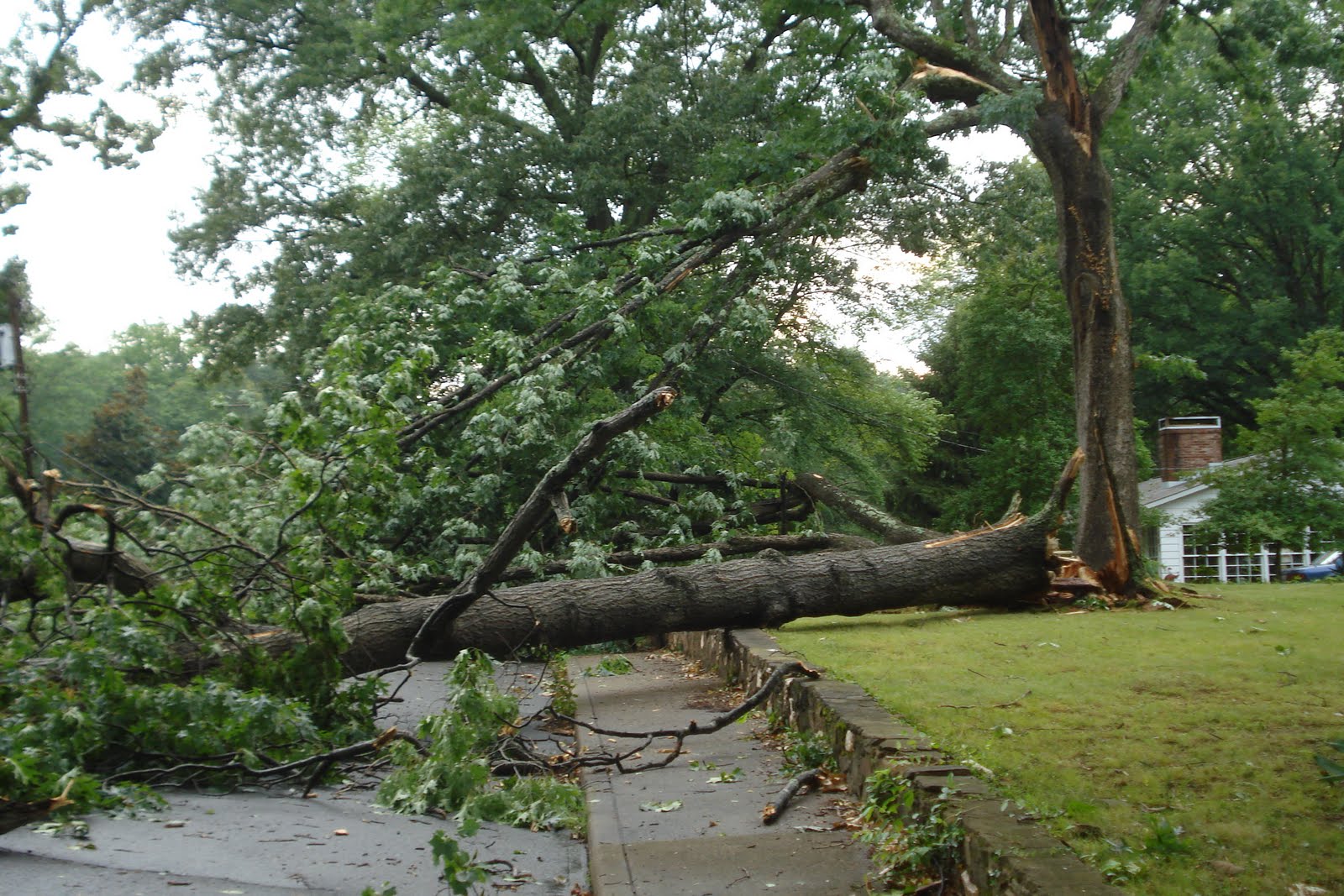
Before this spring, I'd never even heard of a "microburst." Now, we've experienced two in Charlottesville in less than a month.

Yesterday's storm was incredibly intense. The wind and rain started at about 5:15 PM, and I watched trees outside our office window that literally looked like they were spinning in circles.

Like the prior storm, the area around Rugby Avenue seemed to be one of the worst hit. These pictures are from a walk yesterday evening.


Tuesday, June 15, 2010

Charlottesville's Landmark Hotel and the Re-Bricking of Second Street

I've been wondering for some time when downtown business owners would begin getting antsy about the unfinished Landmark and its effect on surrounding properties.

Alas, Dave McNair's got the story in this week's Hook (here): it sounds as though some people are starting to lose (or have lost) their patience. The straw that broke the camel's back is the longer-than-expected City brick work on Second Street.

This is not surprising, since construction was halted approximately 18 months ago (January of '09, I believe) and there's still no news of a possible resolution.

The interesting political theory question that arises, particularly in the comments section of McNair's article, is whether the culprit here is (1) government or (2) the capitalist system.  There's an interesting analogy to the Gulf oil spill, where nobody (Obama included) seems capable of deciding if there should be more or less government involvement in addressing the hole in the ocean.

My reading of the comments is that opinion is split down the middle: some people think the City needs to be more assertive while others argue that there's very little the City could actually do. 

Here's an excerpt from McNair's piece:
Chas Webster figured that by now there’d be a lovely outdoor patio space and a luxury hotel in front of his restaurant The Box on Second Street SE. Instead, he’s looked out on what he describes as a “war zone” for over two years. And it’s taking a toll.
“Yesterday, I couldn’t even get into my own business,” he says, as the entrance to the building had been blocked off, allegedly without notice, by a construction crews under contract to the City.
“It’s ridiculous,” says Webster. “The City promised this would take four months. Now it’s taken almost twice as long as it did to renovate the entire Mall.”
 My earlier posts about the Landmark:
  • November 21, 2009 (here) - Charlottesville Circuit Court rulings in the ongoing litigation
  • July 25, 2009 (here) - Halsey Minor allegations against Specialty Finance Group
  • March 8, 2009 (here) - There'll be no bailout from the City
  • March 1, 2009 (here) - The litigation gets started

Friday, June 11, 2010

McGuffey Park: Why Fix What's Not Broken?

In this week's Hook, Dave McNair reports (here) on the disappointing situation at McGuffey Park.

I was particularly interested in McNair's article because -- when we explored a number of the local parks last year -- I was least impressed with McGuffey. 

Some of the other parks around here are awesome, in terms of landscaping, facilities, and general "aura."  Our experiences in the parks last summer has led to more frequent visits since then.  But McGuffey was not as pleasant or as welcoming, at least not last summer.

The biggest problem I noticed is the lack of trees: most of the places to sit are exposed to the sun, and in addition to that practical issue there's the aesthetic shortcoming of a park without big trees.

When I was a kid, I spent a lot of time at McGuffey, particularly on Saturdays when we'd come downtown to Dad's office and on Sundays after church.  I can remember really liking the merry-go-round (it was the fastest in town, except for the really old one at Meriwether Lewis) and the swingset there.  I also shot a fair amount of hoops on the basketball net (speaking of hoops: Lakers/Celtics appears to be shaping up as a classic; it's 2-2 now and although I've only watched part of one game I've got the impression that both teams are really playing well).

According to McNair's article, there are two major problems confronting McGuffey Park:
  1. The lack of trees -- evidently a number of the mature trees were cut down as part of the 2007 overhaul of the park.  This leads to the sunshine problem that I noticed and has also contributed to significant erosion and drainage issues.
  2. The park has become a gathering area for local teens (particularly on Friday evenings), and nearby residents are complaining about booze/drugs/sex/general bad behavior.
Regarding #2, the analogy is: McGuffey Park is to 2010 as the Hardee's on 250 was to 1991.

The park's makeover in 2007 cost more than $700,000 (unbelievable), including more than $420,000 in City funds. 

An excerpt from McNair on the funding issue:
Ironically, the McGuffey Friends, City officials, former Parks & Rec. director Mike Svetz, and even the Daily Progress editorial staff argued that the renovation would help solve the crime problem that they claimed plagued the old park, where “needles and condoms” were found in the morning. The landscaping firm, Siteworks, claimed that its design would address such problems by “creating better visibility from the street and by providing more potential for flow-through circulation.”

However, several teens a reporter spoke to said that the many benches, long picnic tables, rock walls, and dimly lit areas make it an ideal place for many different groups of kids to sit and hang out. They also said it’s common knowledge that drugs are available in the park. Plus, it’s conveniently located near the Mall.


I think it would probably have been better to spend $400,000 on finding something for these kids to do,” says Rady. “It wasn’t like this before the park was renovated.”
“I was shocked and awed that the city was giving $400,000 for a facelift of one city park,” wrote another nearby resident, Sarah Peaslee, in a letter to the Hook. “Most of us said, If it’s not broke, why fix it?”
Peaslee wondered what would keep out “vagrants and druggies” and predicted that the “lovely, long, fine wood benches” would actually attract more of them. “Help me understand,” she concluded, “why the city spent so much to fix one unbroken park.”